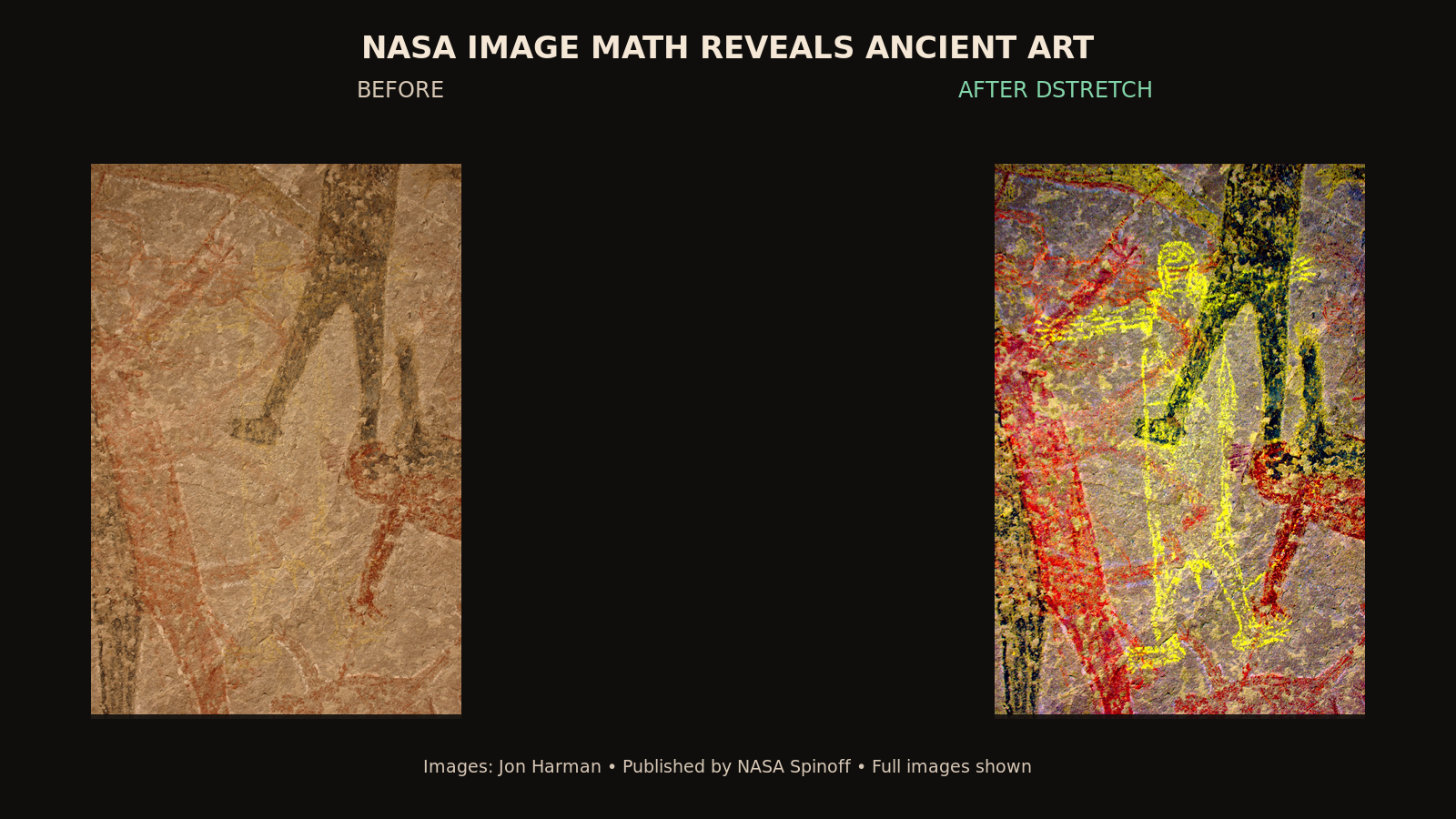
From satellite pixels to stone walls
The method is called decorrelation stretch. It expands subtle color differences so features hidden in a normal image become easier to see. NASA says the technique grew from image-processing work at its Jet Propulsion Laboratory and was documented for satellite-data users in a 1996 paper by JPL employee Ronald Alley.
How it reached archaeology
Rock-art enthusiast and medical-imaging specialist Jon Harman saw the technique applied to Mars imagery around 2005, found NASA's explanation, and built the Dstretch plug-in for ImageJ, an open-source image-analysis program. NASA reports that Singaporean archaeologist Noel Hidalgo Tan used Dstretch between 2010 and 2012 to reveal more than 200 faded paintings at Angkor Wat.
Why it matters
The same approach has helped researchers document previously unseen figures in Norway, unusual animal images in an Egyptian tomb, potential buried structures in Greece, and tattoos on mummified remains. A tool built to pull information from space imagery is now helping preserve evidence from human history.
Confirmed versus uncertain
Confirmed: Dstretch makes subtle color differences easier to detect and has been used in published archaeological work. Uncertain: enhanced colors are analytical aids, not the original appearance of the art. Researchers still have to interpret what a revealed mark represents and verify it with archaeological context.
Sources
Read the original material behind this signal.
Caveman Visionz provides general information and commentary, not individualized financial advice.